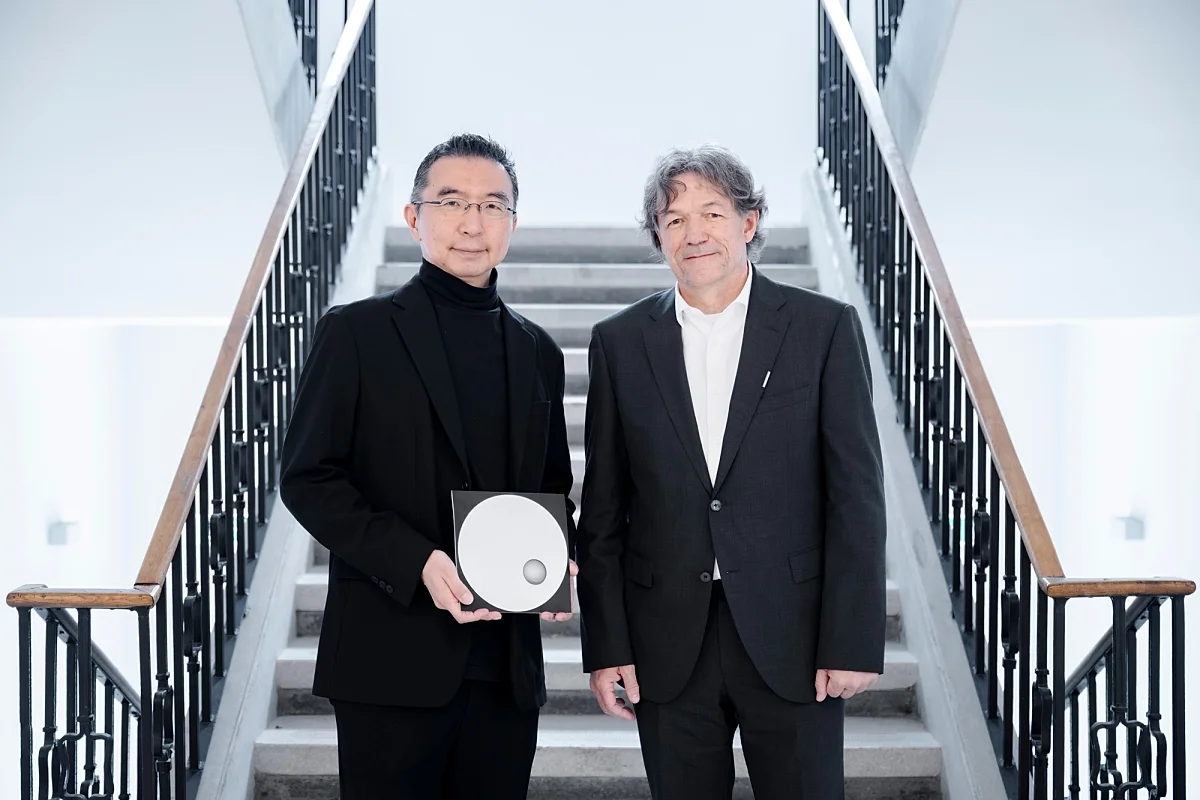
Wherever we are, we share the same sky - Agnes Denes and Sou Fujimoto receive the Moholy-Nagy Award
The ceremony opened with a speech by Interim Rector Csaba Kovács, recalling that the award was founded by Gábor Kopek in 2006, the same year the university adopted the name of photographer, painter, and celebrated Bauhaus teacher László Moholy-Nagy. Alongside his work as an artist and teacher, Moholy-Nagy was a formative intellectual force and the founder of a school of thought. A deeply independent thinker, he pursued universal knowledge through free experimentation and, far ahead of his time, was already confronting in the twentieth century many of the questions we face in the twenty-first. As the rector underlined, this spirit is just as vital to creative practice today as it was a century ago. The freedom to think and operate autonomously remains equally essential to universities and is part of MOME’s DNA. This year’s two recipients are connected to Moholy-Nagy’s legacy through the same openness of thought and commitment to experimentation.
In her laudation speech for Sou Fujimoto, architecture critic Krisztina Somogyi highlighted that the House of Music Hungary embodies many of the ideas that run through the architect’s work as a whole. In her words, City Park is now home to “a building that does not divide, but connects, drawing attention to the transitions between exterior and interior space, Eastern and Western culture, nature and architecture, architecture and music, and the art around us and within us.”
Fujimoto also began his talk with the House of Music Hungary. In the earliest sketches for the project, he drew people dancing and making music in a forest – the challenge was then to translate that scene into architecture. What emerged was a latticed roof reminiscent of a forest canopy, a glass façade blending into the surrounding park, and a building designed around the site’s existing trees. Fujimoto said the greatest joy for an architect is seeing a design come to life, seeing people truly make a building their own and watching it become a place for encounters and interaction. He added that the House of Music Hungary is drawing more and more visitors who feel at home there.
Fujimoto also introduced the Grand Ring created for Expo 2025 Osaka, Kansai, reflecting on a question that emerged during the planning process: what is the point of building something like this for a world expo today? His answer is rooted in the deeply held belief that at a time when global division feels increasingly depressing, architecture, space, and symbolism still have the power to speak to us. “Diversity should never end in division. We can co-exist – and it is precisely through our differences that we can create a shared future.” The House of Music Hungary’s clean circular shape gives physical form to this sense of unity. Looking up through the layers of the structure, visitors glimpse the same sky above every one of us, no matter where we are.
Due to her advanced age, Agnes Denes was unfortunately unable to attend the award ceremony in person. Interim Deputy Rector and Professor Anikó Illés recalled a recent visit to New York, during which a MOME delegation presented the award to the ninety-five-year-old artist.
In her laudation speech for the iconic artist, art historian and MOME Associate Professor Kinga German spoke about how Denes was already raising awareness of the fragility of the planet in the 1970s and early 1980s, developing what she described as “her own eco-logic. At the time, these ideas were far from fashionable, did not seem especially relevant, and held little appeal for the art market.” In Kinga German’s words, Wheatfield – A Confrontation (1982) is “a living mirror that draws attention, prompts us to rethink our priorities, and points to the transformative power of humanity.”
It was Agnes Denes’s request that the university plant a tree in the MOME Campus garden to mark the award ceremony. As Kinga German said at the close of her speech, the tree stands as a reminder of Agnes Denes’s message and legacy, and of the belief that “‘invisible processes’ can be described, drawn, made visible, and ultimately realised together”.
Agnes Denes addressed the audience in a video message, sharing a brief anecdote in an informal, conversational tone. She recalled a formative experience from the final months of the Soviet Union, when she spoke with artists in Moscow about what it means to make art under oppression. The experience led her to realise that human survival – whether in the environmental or the spiritual sense – is only possible through the power of art.
Her creative oeuvre, shaped by a universal outlook, and her large-scale projects that reinterpret spaces and landscapes draw attention to the Earth’s fragility, humanity’s responsibility, and the power of human values. She creates her work for humanity as a whole, bringing together human and non-human elements, as well as mathematics and visual art.
In parallel, Sou Fujimoto’s architectural practice explores the relationship between the natural and built environment. His buildings, which create new spatial experiences, highlight the importance of human scale, liveability, and shared experience, while reflects on the relationship between the human body and architecture.
Their works do not offer simplified answers, yet convey a positive vision: Denes emphasises the power of hope, while Fujimoto expresses optimism for the future. The relationship to nature, responsibility the built environment carries, social awareness, and a sense of responsibility for the future are all central to both bodies of work, just as they are core values at MOME.
The Moholy-Nagy Award ceremony was followed by the Spring Title Award ceremony, which offered a glimpse into the diversity of MOME’s doctoral community. The works of the university’s newest doctoral graduates reflect on some of the most pressing issues in contemporary design, art theory, architecture, animation, and visual communication.
More details...
More news