The finalist projects of the Jump into the Future! competition have been announced
Jump into the Future! is far more than an ideas competition: it invites participants to think about the future in teams and give form to their ideas through objects, services, systems, or architectural and visual concepts. The teams selected for the next round can develop their proposals further with the help of MOME mentors, while also learning about design methods, prototyping techniques and the basics of storytelling in MOME workshops. In this sense, the competition is not only about creativity, but also about shaping a more positive, action-oriented vision of the future. This year, ten teams have once again reached the final. Their projects are introduced below.
CEF
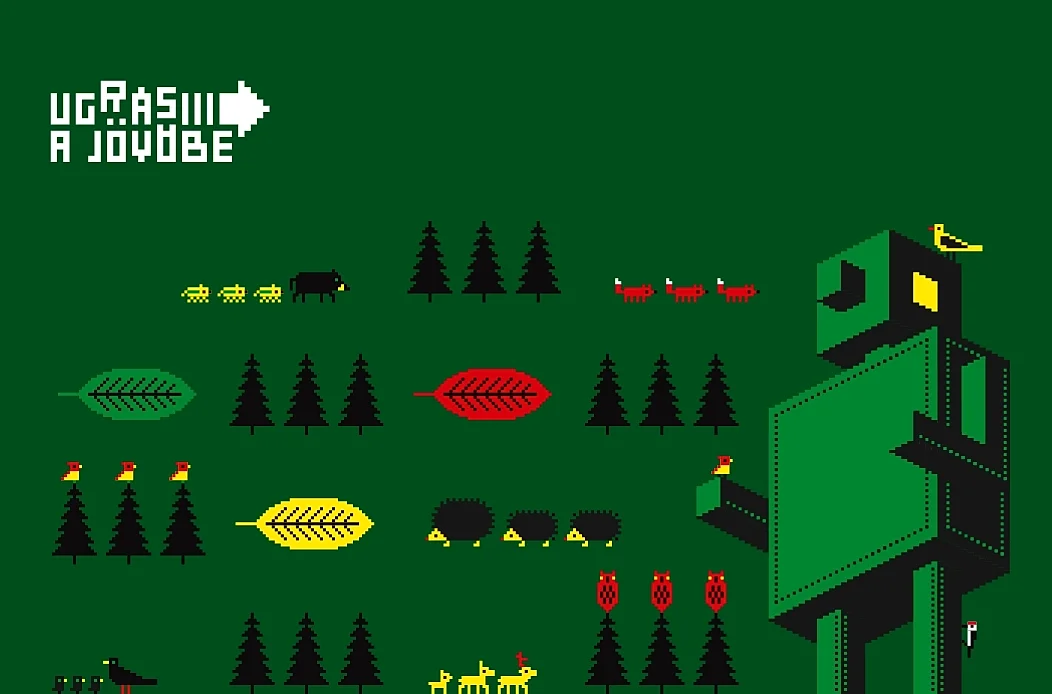
The CEF team imagines a future forest-protection system in which insect-like robots help monitor the condition of trees. GOB and ROB translate the trees’ vibrations into colours, making the forest’s signals visible, while students and volunteers can also become part of the system. In this concept, forest protection becomes a technological, community-based and educational task all at once.
dECO
dECO envisions a living ecological-technological system built around mangrove trees, responding to overheating, water scarcity and the energy demands of the built environment. The dome-like structure uses the heat and airflows produced by AI centres, while the mangroves help circulate water, filter gases, produce oxygen and create a distinctive microclimate.
Sketchsquad
Sketchsquad presents a more sustainable, greener city of the future, where nature is not pushed out of the urban environment but becomes an integral part of it. In this concept, roof gardens, solar panels, vacuum trains, energy-generating floor surfaces and elevated walkways connect the buildings, while car traffic moves into the background. We discover the city through the eyes of a stray cat, giving the technological and environmental solutions a personal, storybook-like frame.
GreenTechGirls / The Clearing
GreenTechGirls / The Clearing imagines a support centre hidden in a forest, created to help young people and offer a nature-based response to teenage mental wellbeing. The project suggests that one of the key questions of the future is not only how we protect forests, but also how we can find safe, attentive and healing spaces within them. At The Clearing, young people are supported by a psychologist, a dietitian, a library, a sexologist, a study-methodology space, a quiet room, a creative corner and a garden. The concept understands the forest as a place of trust, regeneration and community care.
AgraBorius / ArborLink
The AgraBorius / ArborLink app and sensor system would reconnect people in cities with trees. Plant-friendly sensors would monitor the condition of trees, while the app would translate their needs into clear signals: water, nutrients or care. Users could adopt individual trees, collect points for looking after them and build a more direct relationship with urban nature. The project invites us to see trees not as background scenery, but as perceptible urban companions that need care.
Symbiotes / Harmony
Symbiotes / Harmony imagines a future in which the relationship between humans and nature is built on genuine coexistence. The project begins from a personal place, moving from the experience of urban loneliness and disconnection from nature towards a community movement. In the concept, fungal threads transport water and messages, adobe houses are built onto trees, clothes are made from living materials, and reconnecting with nature also affects people’s mental state. Harmony describes the forest not as a resource, but as a sensitive, cooperative system.
Holy Humus / The Earthworm as the Breath of God
Holy Humus / The Earthworm as the Breath of God is built around a renewed understanding of fertile soil, composting and the cycle of life. It begins from the idea that people in cities have become detached from both the Earth and the soil, even though soil is one of the foundations of life. The installation would use earthworms to create humus in an urban environment, while giving new meaning to living creatures many people regard with aversion or disgust. At the heart of the concept is the idea that our relationship with soil can be not only environmental, but also sensory, spiritual and communal.
Forest Hermits
Forest Hermits imagines relearning the relationship between humans and nature as a critique of a technology-dependent future. Told in diary form, the story begins with an urban life built around robots, which collapses after a system failure and forces a family to move close to the forest. Their new way of life involves more physical work, cycling, shared family activities and less reliance on machines. The project asks what humans might regain by stepping out of full automation and entering into a more direct relationship with nature again.
Future4U / The House of the Future
Future4U / The House of the Future begins from a dystopian environmental scenario in which the disappearance of forests, lack of air and acid rain are already threatening human survival. The team’s solution is a multifunctional, mushroom-like building that acts as a living space, a shade-giving structure, an energy-generating system and a source of oxygen. The concept draws on forms found in nature, while offering an architectural and technological response to an extreme future problem.
UrbanNature / Fánti Van
UrbanNature / Fánti Van offers a practical, community-based response to water scarcity and drought. The elephant-like vehicle, designed in the spirit of a fire engine, collects household wastewater, cleans it and then uses it to water trees and plants in gardens. The free service would support water saving and plant care, while also encouraging people to plant trees. In this concept, technology connects to everyday environmental responsibility in a playful, easy-to-understand form.
Each of the submitted projects is framed by a surprisingly rich story: they unfold as diaries, future recollections, fairytale-like city walks or speculative narratives built from personal memories. Together, they speak both to the environmental and social awareness of an age group that, according to surveys, is increasingly affected by eco-anxiety, and to the boundless imagination with which students are able to think about the complex problems of the future. Their responses to often serious crises and challenges are nevertheless hopeful, showing that even at a young age, the future can be discussed with design curiosity, collaborative thinking and an imagination geared towards action.
More news