Spring Title Award ceremony: MOME’s doctoral community continues to grow
This year’s ceremony opened with welcome speeches by Interim Rector Csaba Kovács and Head of the Doctoral School Hedvig Harmati. Hedvig Harmati underlined that the ceremony honours individuals who, despite the increasingly warped cultural climate of recent years, continued to believe in the freedom of science and creative work. “Let them serve as role models at a time when university autonomy matters more than ever. If, even at this historical moment, we fail to understand that this autonomy is built first and foremost on the personal intellectual autonomy of doctors, habilitated scholars, and professors – in other words, our qualified colleagues – then we will once again miss a historic opportunity. Just as the temple of science is built from the polished stones of scientific achievements, university autonomy cannot exist without those who uphold it through their work, sense of responsibility, and intellectual integrity.”
Next, eleven doctoral degrees were awarded. Photographer Dániel Halász’s research reflect on the resilience of Hungary’s smallest villages, and Péter Horányi analyses forms of presence in documentary filmmaking in the digital age. In her architectural dissertation, Boglárka Magda Jakabfi-Kovács examines the principles of degrowth and design for care, while Andrea Szakál looks at the adaptive reuse of existing building stock through the lens of hedonistic urbanism.
In the fields of visual communication and graphic design, Ágnes Jekli explores the possibilities of intercultural dialogue, Balázs Vargha the visual systems of Hungarian national and state symbols, and Zoltán Zeman the contemporary role of critical design in graphic design practice.
In animation, Orsolya Láng focused on Eastern European animation traditions, while Viktória Júlia Traub on anthropomorphic character representation. In her research, Krisztina Maróy looked at the power of fashion to shape society, and Benedek Sebastian Purkarthofer interpreted the culture of the Wunderkammer through the lens of contemporary design theory.
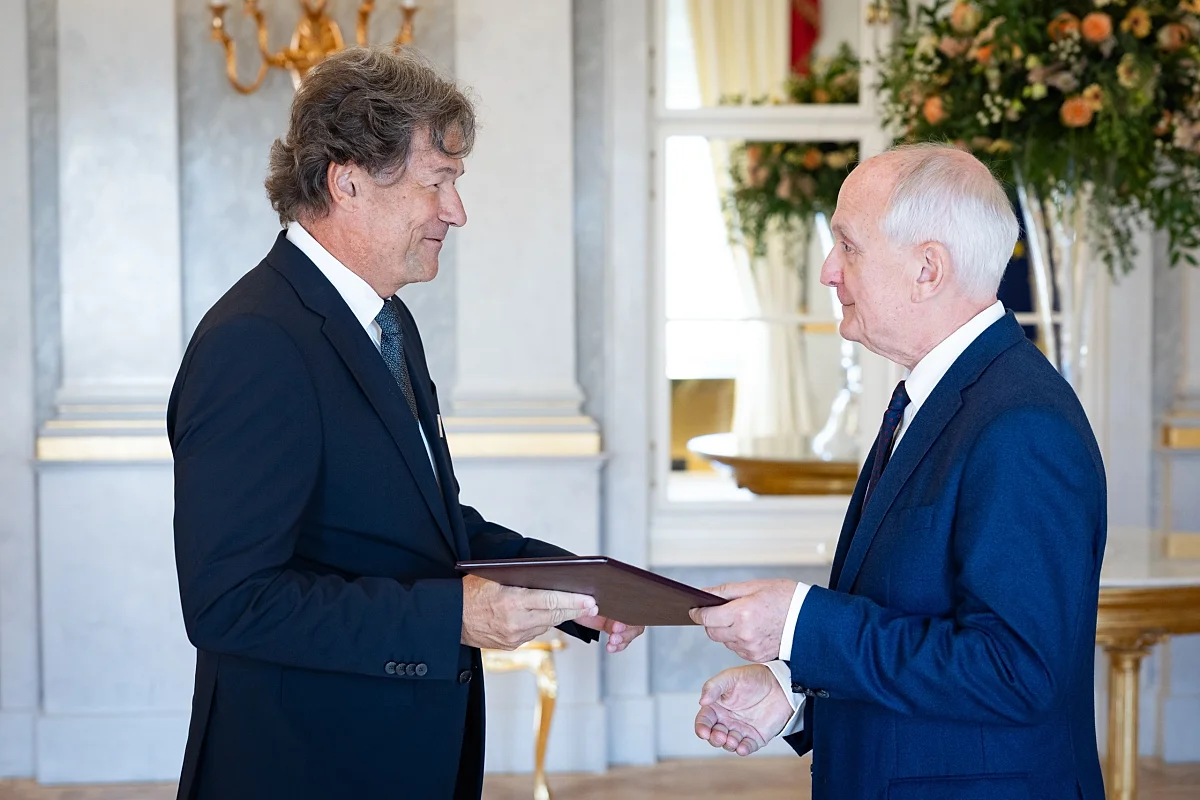
During the ceremony, designer Dr Róbert Mascher received his habilitation title in recognition of his work that has had a lasting impact on visual education and industrial design practice both in Hungary and internationally.
The Spring Title Award ceremony celebrated not only academic and artistic achievements, but also reflected MOME’s interdisciplinary outlook. Despite their wide-ranging subjects, the projects shared a commitment to research-driven creative practice, interdisciplinary approaches, and sensitivity to social, cultural, and ecological questions.
Bringing the event to a close, guitarist Gáspár Thorpe performed his own composition, Mező, a crossover piece inspired by folk music.
More news