MOME joins a three-partner healthcare project
The family-oriented ward and the multifunctional furniture designed for relatives will improve the comfort of parents whose children are recovering in hospital. This matters because parental presence has been shown to reduce the stress of a hospital stay and to positively affect children’s recovery, delivering clear social and health benefits. MOME’s staff are working on developing the ward concept and the functional furniture at the request of the Ronald McDonald House.
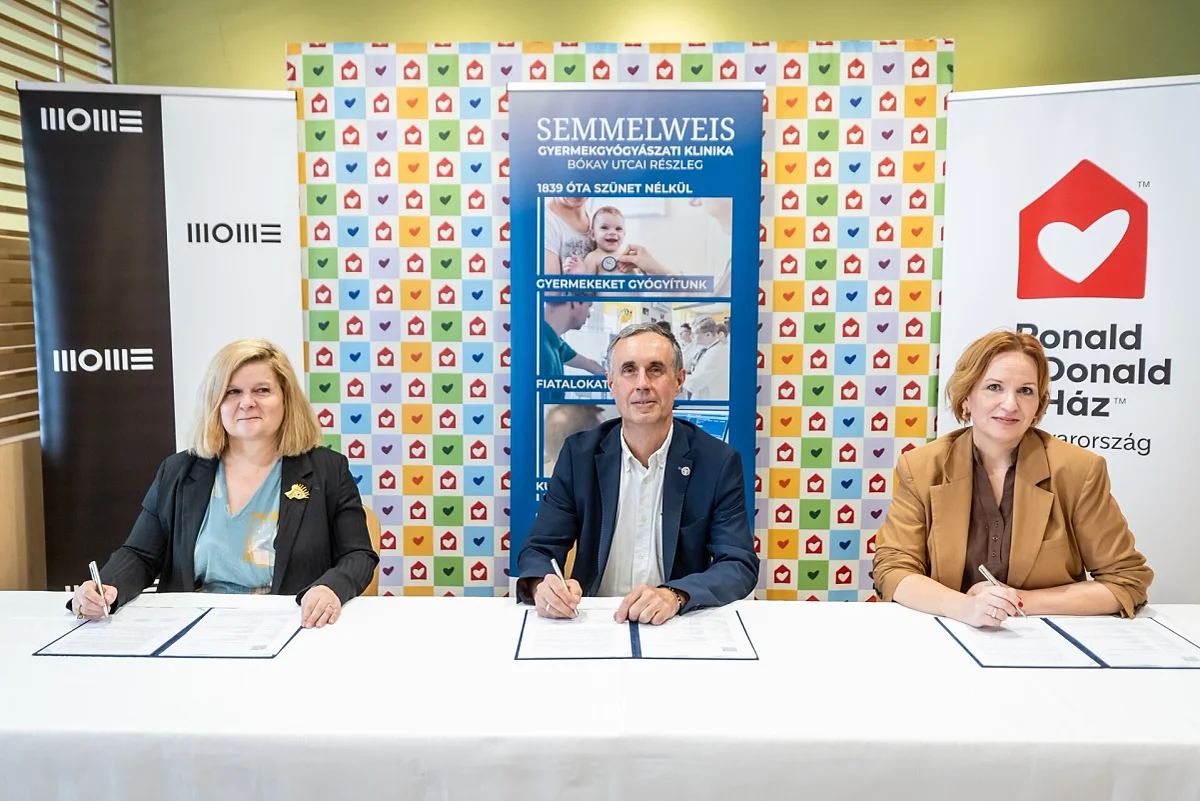
The collaboration began on 17 June with a ceremonial signing of the agreement by Managing Director of the Ronald McDonald House Hungary Zsuzsanna Répássy, CEO of the Moholy-Nagy University of Art and Design Réka Matheidesz, and Director of the Semmelweis University Pediatric Center and Vice-Rector for Clinical Affairs Professor Attila Szabó. The project is an exemplary joint effort, bringing together the non-profit world, design-led service development at university level, and the healthcare sector. Once the prototype has been tested, the resulting furniture will go into production for use in hospital wards.
Ronald McDonald House Charities Hungary’s mission is to bring into hospital wards the same family-centred approach that underpins the work of the Ronald McDonald Houses it operates. “We would like the hospital environment to feel not only functional, but also humane, calming and emotionally supportive for children and their families.” This is why we looked for a partner who can combine creativity, empathy, and practical thinking. We believe that MOME’s design mindset and innovative approach can help develop genuine, tangible solutions that bring us closer to creating hospital spaces that are even more child- and family-friendly,” said Dr Ágnes Török, programme development manager at Ronald McDonald House Charities Hungary.
The collaboration is the third stage of a product development process that began earlier. In spring 2024, MOME launched a research project that ran for several weeks, with students on the university’s service design specialised training course working with the Pediatric Centre of Semmelweis University on three complex service development projects.
The research produced proposals designed to improve the experience of patients and their family members while helping healthcare staff work more efficiently. Building on these results, students from MOME’s Design MA programme joined the collaboration in autumn 2024, designing furniture and objects for hospital wards to make them more comfortable for parents and children. Alongside the bed itself, several students worked on new storage solutions and other features designed to improve comfort.
“For MOME, collaborations like this are not simply opportunities – they are essential to ensuring that our knowledge and creative capacity deliver real, measurable benefits for society. We believe design and innovation fulfil their true purpose when they serve the wider community. That is why it is a top priority for us to apply our expertise actively and responsibly to tackling society’s most pressing challenges,” said MOME CEO Réka Matheidesz.
From the outset, Director of the Semmelweis University Pediatric Center Professor Attila Szabó was open to the collaboration and provided space for the students carrying out the research and service development work. “Our family-centred approach means that parents can remain by their child’s side day and night at all times except when this would compromise the safe delivery of care. Evidence shows that a parent’s presence provides a sense of security that can support a child’s recovery. Our collaboration with the Semmelweis University Pediatric Center and the Ronald McDonald House Charities Hungary is built on that understanding, focusing on how we can make hospital stays more comfortable for parents. We are delighted to be part of a project that has the potential to benefit families in paediatric hospitals across Hungary.”
Now in its third phase, the project builds on the work completed during the first two stages. Feedback on the initial concepts has provided a clear picture of the priorities that matter most to children, parents, and healthcare professionals. The team leading the project through to the first prototypes includes Head of the Service Design programme Fanni Csernátony DLA, Head of the Design BA Dorottya Féja, and industrial designer Ádám Miklósi. The final prototype is expected to be completed by autumn 2027, when the design is also due to go into production.
“For me personally, the project with the Semmelweis University Pediatric Center has reinforced just how important service design methodology can be in improving healthcare. The students’ research showed that children’s recovery is influenced not only by the quality of medical care, but also by the environment around them, their parents’ wellbeing, and whether their hospital stay provides a sense of safety and support. Design methodologies provide a framework for thinking through these considerations”, said Head of the Service Design programme Fanni Csernátony DLA.
Head of the Design BA Dorottya Féja added, “In this project, service design and product design go hand in hand. A piece of furniture, a storage solution, or a new element within a hospital ward is rarely a solution in itself. It always forms part of a wider service system in which children, parents, and healthcare professionals are all equally involved. I believe good design takes everyone's perspective into account. Rather than offering one-size-fits-all answers, it responds to clearly identified problems with targeted, practical solutions. It is where research, systems thinking, and product design come together to address a real societal challenge.”
Ronald McDonald House Charities Hungary
Since 1994, the Ronald McDonald House Charities Hungary has supported families whose children need long-term hospital treatment far from home. Since its foundation, the charity has helped more than 16,000 families. Its Ronald McDonald Houses in Budapest and Miskolc, together with its Family Centre in Debrecen, offer families free accommodation in a home-like environment, allowing them to stay close to their children throughout their treatment. The charity is also dedicated to promoting family-centred care across paediatric healthcare in Hungary. It believes that the presence of parents, emotional security and family bonds are all essential to a child's recovery.
Semmelweis University Pediatric Center
The Semmelweis University Pediatric Center is one of Hungary’s largest and most comprehensive paediatric healthcare institutions. It serves as a national referral centre across a wide range of specialties, from neonatology and paediatric oncology to organ transplantation. Each year, the centre provides inpatient care for around 20,000 children and outpatient care for approximately 200,000 patients. Alongside delivering high-quality clinical care, it is committed to scientific research, educating the next generation of paediatricians, and improving health literacy through nationwide awareness campaigns, screening programmes, and public education initiatives.
https://semmelweis.hu/gyermekklinika/
Moholy-Nagy University of Art and Design
The Moholy-Nagy University of Art and Design (MOME) was founded 145 years ago and is one of the leading design higher education institutions and major art and innovation hubs of the region. Its mission is to leverage design-based learning, research, and practical expertise to deliver bold and credible responses to the most pressing challenges of the 21st century while addressing the needs of future generations. MOME is dedicated to serving the broader community and fostering a culture of design awareness to support the development of Hungary’s and Central Eastern Europe’s economic and cultural ecosystems.
More news