Data in space
The course focused on creating interactive data physicalisations and installable data sculptures that support awareness, involve the local community, and translate the causes, effects, and possible consequences of climate risks – which are expected to have a direct impact on quality of life in the future – into clear spatial forms. Students examined the climate challenges facing District XII, in particular how data about the future, can take physical form and become something people can experience for themselves.
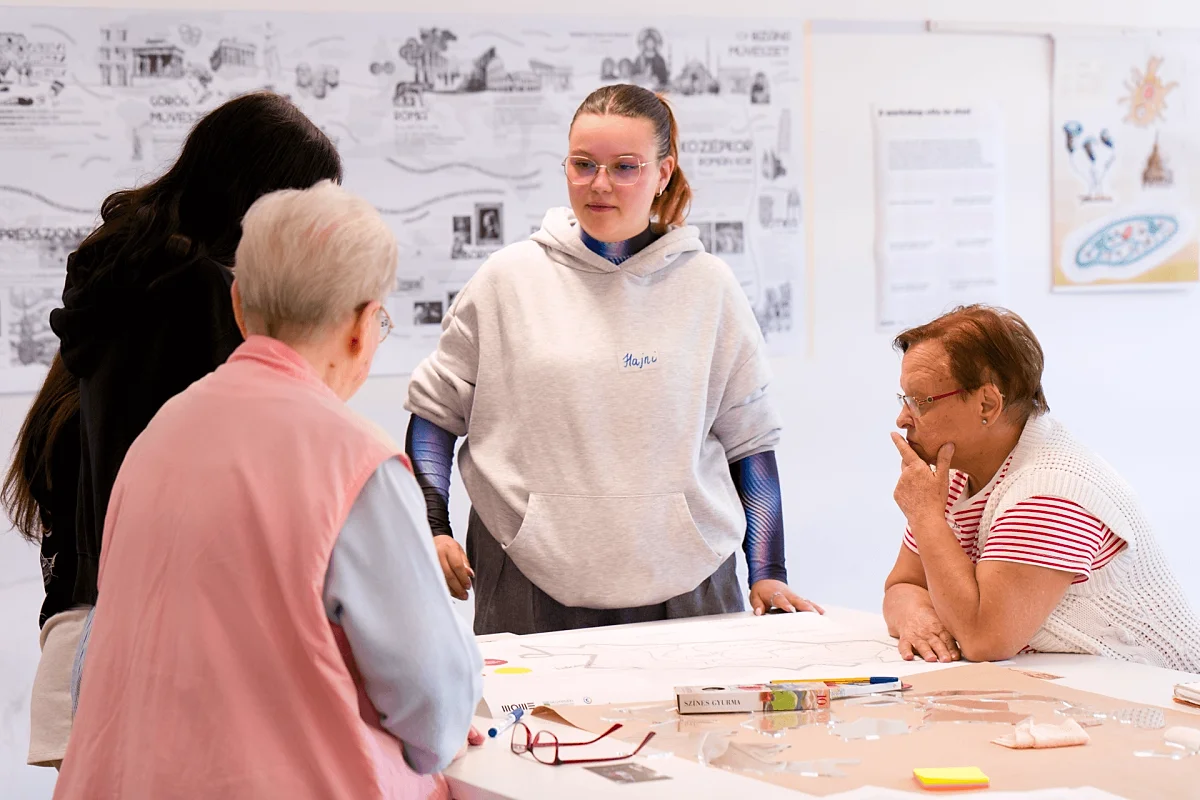
During the research phase, students analysed and worked with data provided by the Municipality of Hegyvidék and the CLIMAAX programme, before translating it into spatial form. Under the supervision of Ákos Lipóczki DLA, Mihály Minkó, and Borka Moravcsik, they developed objects whose materials, forms and modes of interaction respond directly to the climate risk each student had chosen. The projects were finalised in joint workshops with students from Zugligeti Primary School and their grandparents, helping foster intergenerational dialogue and raise awareness of the issue.
Bakai Hajnalka’s installation A Horizon Coming into Focus responds to the growing problem of heavy rainfall projected for 2070. The project traces the path of water rushing down from Normafa to Déli railway station, highlighting the critical points where Hegyvidék’s steep streets, built-in valleys and impermeable surfaces of concrete and asphalt accelerate runoff. It combines the topography of District XII with data from the RCP4.5 climate model, making the tension between natural water retention and artificial hard surfaces immediately visible through the contrast between wood, terracotta, and concrete. The piece warns of the risk of flash floods, while also pointing out the fragile natural balance of the urban environment.
Nikoletta Fanni Kovács’s work focuses on one of the most tangible consequences of climate change: the expected impact of heatwaves and how that impact varies from one area to another. Using shading data provided by the municipality for the period 2031–2060, the installation examines to what degree different parts of the district are likely to be exposed to heat stress, and how trees and shaded areas can improve the urban microclimate. In the installation, the spacing of the support posts represents the amount of shaded surface, their height indicates the severity of the risk, and the shades of the textile signal increasing levels of exposure. Read from left to right, the spatial system leads visitors from the more favourable microclimate of János Hill to the denser, hotter zone around Déli railway station.
Katalin Júlia Sulyok’s data sculpture contrasts current drought levels in the district with projections for 2040–2070. In the seesaw-like installation, sand and water serve as physical equivalents for the data. Areas of the district are assigned drought-sensitivity scores on a scale of 1 to 10, represented by columns of different heights. The amount of sand placed in each column indicates the severity of drought. Because the projections point to significantly drier conditions in the future, the balance tips visibly to one side. It can be restored with water, a symbolic interaction that points to the key role of retaining rainfall, storing water, and using water consciously in mitigating future droughts.
Students: Hajnalka Bakai, Nikoletta Fanni Kovács, Katalin Júlia Sulyok
Instructors: Associate Professor Ákos Lipóczki DLA; researcher Mihály Minkó; designer and external lecturer Borka Moravcsik
Partners: Municipality of Hegyvidék; Green Office of the Municipality of Hegyvidék; MOME Zero – Ecological Sustainability Office; the MOME Ecology and Action Lab; Zugliget Primary School
More news