Pollinator Day at the MOME Campus

Date: 2025.05.08
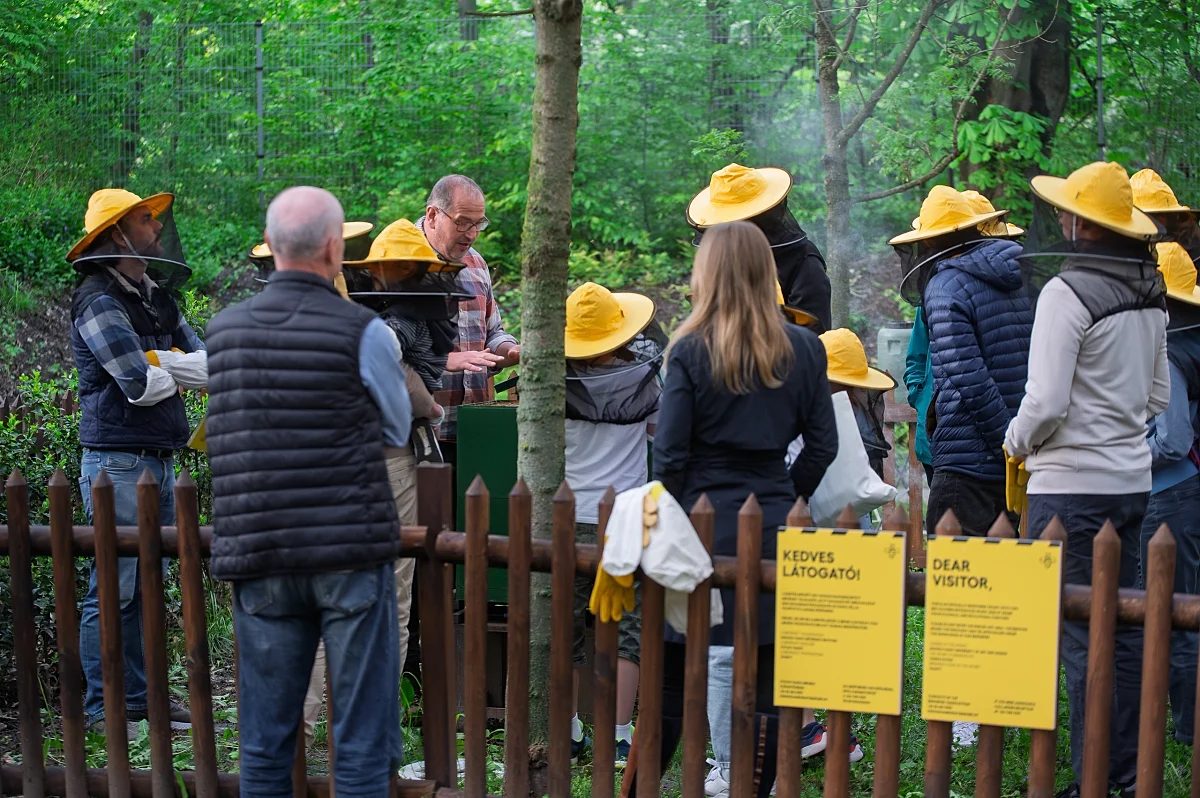
What plants are pollinator magnets, and what should we do to create a bee pasture in our garden? These and similar questions were addressed by the Pollinator-Friendly Programme of the Hegyvidék Local Council, which has MOME as a partner. Visitors were treated to a special seed mix sale, engaging talks on the subject, and a peek into the MOME beehives.

The event offered a fascinating insight into the ongoing pollinator-friendly initiative in the district, alongside the history of MOME's own apiary and MOMÉZ, MOME’s honey. Head of Cabinet of the MOME Foundation Eszter Sisák highlighted the university’s commitment to sustainability. She explained the motivation behind establishing MOME's beekeeping initiative and stressed that the goal wasn’t only to raise awareness but also to train students to incorporate sustainability into their design processes. MOME's beekeeper Tamás Kutasi shared intriguing facts about the lives of bees, including the impact of their winter decline, and how it has made it even more important to focus on the health and sustainability of each individual hive. For the more adventurous visitors, there was an exciting opportunity to suit up in protective gear and get a closer look at the hives. 

Nóra Laki from the Hegyvidék Green Office underlined the event's aim to establish a lasting tradition, while research associate at the Lendület Ecosystem Services Research Group Viktor Szigeti spoke about the importance of maintaining nature-based habitats and the key tasks of observing plants and pollinators in the field.  The discussion also touched on topics such as less frequent mowing, wildflower patches, and the Pollino project, introduced by MOME junior researcher Kitti Butter. 

The Pollino initiative is an exciting blend of design, ecology, and urban planning, exploring how urban spaces can be transformed to meet the needs of pollinators, thus enhancing biodiversity and resilience in the local environment. 

Conservation biologist András Máté (Wildflower World) focused on the role of native plants in urban areas. He shared a sobering fact: the decline in insect populations has not slowed in recent decades, highlighting the importance of continuing efforts to protect our natural world. 

https://hegyvidek.hu/ugyintezes/zold-iroda/kedvezmenyes-beporzobarat 

https://mome.hu/en/projects/pollino 

More news

A 2026. április 12-i választással egyértelmű és megkérdőjelezhetetlen felhatalmazás született a tudományos szabadság és a felsőoktatási autonómia maradéktalan helyreállítására, valamint a szférának az Európai Kutatási és Felsőoktatási Térségbe való visszatérésére. A MOME Szenátusa ezúton kinyilvánítja, hogy élni kíván a változás lehetőségével, ezért a továbbiakban autonómiájának újjáépítésén fog dolgozni.
A „Helyzet van!” programsorozat nemcsak beszélgetést indít, hanem konkrét válaszokat is keres arra, hogyan lehet biztonságosan és felelősen működni egyetemi közegben. Nem mindig egyértelmű, hogy egy helyzet „belefér-e”, vagy már határsértő. A MOME tavasszal indított kezdeményezése ezekhez kínál kapaszkodókat: hogyan működnek a szabályok a gyakorlatban, és hova lehet fordulni, ha kérdésed van. Folytatjuk dr. Sebestyén Andreával (jogász, tréner, coach) indított beszélgetésünket, ezúttal ezekről a határhelyzetekről.
„Helyzet van!” – mondjuk, amikor érezzük, hogy valami nincs rendben, de nehéz pontosan megfogalmazni, hogy mi zavar bennünket, mit tehetnénk. A MOME szemléletformáló programsorozata épp ezekre a helyzetekre keres közös nyelvet: hogyan lesz egy szabályzatból valódi gyakorlat, és miképpen lehet biztonságosabban működni egy kreatív közösségben. A 2026 márciusában indult eseménysorozat szakmai vezetőjével, egyik szakértőjével, dr. Sebestyén Andreával (jogász, tréner, coach) beszélgettünk a határokról, a felelősségről és a tudatosságról, valamint arról, hogy mi kell a változáshoz.
Member of the European
Network of
Innovative
Higher Education Institutions
9 Zugligeti St,
Budapest, 1121