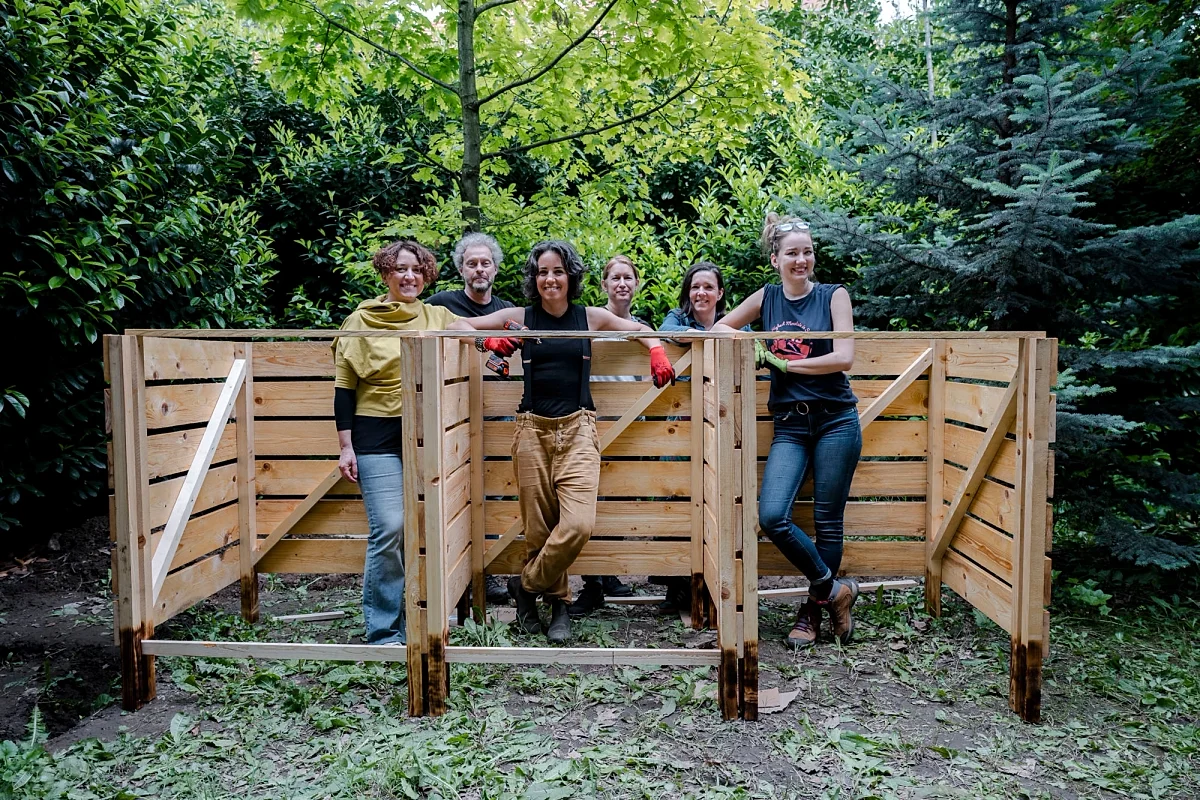
MOME’s first ever community composting station is taking shape

Date: 2025.06.25
The MOME ZERO sustainability programme has reached another important milestone. Designed in collaboration with students, the new composting station will support more sustainable waste management practices on campus from the autumn term. Closely tied to the new community garden also opening later this year, the composting station is more than just a facility – it’s a shared learning environment where students, teachers, and staff have worked together to rethink how green waste is used and reused.

Students were involved right from the start, from identifying needs and gathering inspiration to conducting research, contributing to the design process and creating the final construction plans, which were completed by two architecture students. 

As the composting unit took shape, participants took on tasks ranging from planing and surface treatment to final assembly. Along the way, they also learned the principles behind composting and its environmental benefits. The workshops combined a strong sense of community with a deeper understanding of sustainable thinking and practical know-how. The experience proved so engaging that many of the original participants went on to invite others to join. 

The Budapest100 Festival, which this year focused on urban green spaces under the theme Public/Green, also offered an opportunity for MOME to open its gates to local communities and demonstrate how urban composting and community gardening can become tools for sustainable transformation within the urban fabric. 

Initially, the composting station will serve the needs of the MOME community garden by processing plant-based waste. In the long term, the aim is to integrate green waste from across the entire 1.5-hectare campus into the system. Plans are also underway to add sensors that will track temperature, moisture, and organic content. Rather than being simply published, the data sets will be processed using data visualisation methods. For instance, digital object makers may even explore how to physicalise this information, while others will use it to help develop the perfect “compost recipe.” The project also has an educational component: students and visitors will be able to learn more about composting through awareness-raising activities. More than just a physical structure, it is a live experiment in how design and collaboration can offer thoughtful responses to complex environmental questions. 

The project is part of the KompoSztár/GiliSztár initiative and is funded by the MOL New Europe Foundation’s Green Oasis 2025 grant. 

More news
A 2026. április 12-i választással egyértelmű és megkérdőjelezhetetlen felhatalmazás született a tudományos szabadság és a felsőoktatási autonómia maradéktalan helyreállítására, valamint a szférának az Európai Kutatási és Felsőoktatási Térségbe való visszatérésére. A MOME Szenátusa ezúton kinyilvánítja, hogy élni kíván a változás lehetőségével, ezért a továbbiakban autonómiájának újjáépítésén fog dolgozni.
"A rajzokban ott marad a mozdulat, a történetekben ott marad a lélek." A Moholy-Nagy Művészeti Egyetem közössége, az Animáció szak oktatói, jelenlegi és volt hallgatói fájó szívvel és megrendülten búcsúznak egykori hallgatónktól, Kádár Klaudiától, a végtelenül érzékeny, mély intellektussal és finom látásmóddal megáldott fiatal alkotótól.
What happens when it is not adults, but secondary school students, who begin thinking about the future? Ten student teams presented their ideas at this year’s final, with participants reflecting together on the kinds of relationships that humans might develop with technology and nature twenty years from now. This year’s theme was the forest. The visions presented by the participants touched on climate change, urban life, automated systems, collective responsibility, and the possibility of reconnecting with nature. First prize from the jury went to Sketch Squad, with dECO taking second place and Erdei Remeték third. Seven special prizes were also awarded at the final, recognising the different strengths, approaches, and community values of the submissions.
Member of the European
Network of
Innovative
Higher Education Institutions
9 Zugligeti St,
Budapest, 1121